


Video Poker Variants
Video poker variants explained: Jacks or Better, Deuces Wild, Double Bonus, Joker Poker and more. Structural differences, hand rankings and paytable rules.


|
Tip |
What it covers | |
|
|
Check the paytable before the first hand |
Paytable structure and how to read it |
|
|
Know the hand rankings for the variant you are playing |
Why rankings differ across variants |
|
|
Understand how coin count affects payout tiers |
The Royal Flush top-tier mechanic |
|
|
Identify the variant before the deal |
Structural differences between common variants |
|
|
Use free play to observe the game format |
What demo play is and is not useful for |
|
|
Understand that each hand is an independent event |
Game randomness and hand independence |
|
|
Know the minimum qualifying hand for the variant you are playing |
Paytable floor and qualifying thresholds |

Tip
Check the paytable before the first hand
What it covers
Paytable structure and how to read it

Tip
Know the hand rankings for the variant you are playing
What it covers
Why rankings differ across variants

Tip
Understand how coin count affects payout tiers
What it covers
The Royal Flush top-tier mechanic

Tip
Identify the variant before the deal
What it covers
Structural differences between common variants

Tip
Use free play to observe the game format
What it covers
What demo play is and is not useful for

Tip
Understand that each hand is an independent event
What it covers
Game randomness and hand independence

Tip
Know the minimum qualifying hand for the variant you are playing
What it covers
Paytable floor and qualifying thresholds
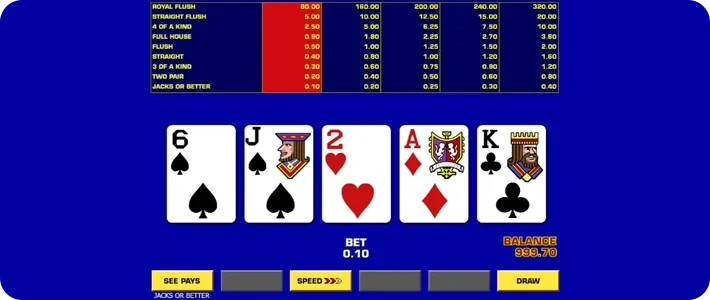
 The paytable is always displayed on screen before and during play. It lists every qualifying hand and the payout multiplier for each: the Royal Flush at the top, the minimum qualifying hand at the bottom. Reviewing it before the first hand confirms what the game pays for each result.
Paytable configurations vary between instances of the same variant. A 9/6 Jacks or Better paytable pays 9 times for a Full House and 6 times for a Flush. An 8/5 version of the same variant pays 8 times and 5 times for the same hands. Both are standard configurations: neither is an error nor a promotional variant. Checking the paytable before the deal is how you confirm which configuration is in play. For a full paytable reference across configurations, see video poker paytables.
The Royal Flush row typically shows two separate values: one for bets of 1–4 coins and a higher value for the maximum coin bet. This is a structural feature of most variants, built into the paytable as a fixed rule, not a special promotion.
Standard hand rankings (Royal Flush at the top, down to the minimum qualifying pair) apply across most video poker variants. However, wild card variants modify the hierarchy in ways that are worth knowing before play begins.
In Deuces Wild, all four 2s are wild cards. Because wild cards make pairs and other high-ranking combinations more achievable, the minimum qualifying hand rises to Three of a Kind; pairs no longer qualify. Additionally, the wilds add a chance to get Five of a Kind hand, which typically payout 15-1. The Royal Flush is also split into two separately valued hands: Natural Royal Flush (formed without any wild cards) and Wild Royal Flush (formed with one or more deuces substituted). Natural Royal Flush hands pay at higher rates because they occur less frequently than Wild Royal Flush hands featuring a 2 as a wild card.
In Joker Poker, one Joker card is added to a 53-card deck and acts as a wild. The minimum qualifying hand typically rises from Jacks or Better to Kings or Better or Two Pair, depending on the configuration. The same Natural/Wild Royal Flush split applies as well as the addition of Five of a Kind hands.
Checking the hand rankings for the active variant before the deal confirms which hands qualify and at what payout level. See video poker hand rankings for a full hierarchy reference, and the video poker variants page for structural differences between all variants.
In most video poker variants, the Royal Flush payout is structured differently from every other hand on the paytable. All other qualifying hands pay proportionally: a Full House at 9 times returns 9 coins on a one-coin bet and 45 coins on a five-coin bet. The Royal Flush does not follow this pattern.
Instead, the Royal Flush is configured with two separate payout tiers: a standard multiplier for bets of one through four coins, and a significantly higher multiplier for the maximum five-coin bet. On a 9/6 Jacks or Better paytable, a Royal Flush on a one-coin bet pays 250 coins (250 per coin bet); on a five-coin bet, it pays 4,000 coins (800 per coin bet). This two-tier structure is a fixed rule built into the paytable. It is not a promotional feature and is not exclusive to any specific platform or game.
All other hands in the standard paytable pay proportionally regardless of coin count. The Royal Flush tier is the only hand structured this way in most variants. See video poker paytables for the full paytable reference.
The variant name is always displayed on the game screen. It determines the deck configuration, wild card rules, minimum qualifying hand, and paytable structure, all of which differ between variants. Confirming the variant before the first deal means you know which hand rankings apply and what the paytable floor is.
The most structurally significant differences between common variants are: wild card presence (Deuces Wild and Joker Poker use wild cards; Jacks or Better and Double Bonus do not) and the minimum qualifying hand, which varies from a pair of Jacks (Jacks or Better, Double Bonus) to Three of a Kind (Deuces Wild) to Kings or Better or Two Pair (Joker Poker).
Double Bonus Poker uses the same baseline structure as Jacks or Better but applies enhanced payouts to specific Four of a Kind hands(four Aces and four 2s/3s/4s) as well as Full House hands. Other paytable rows are adjusted to offset these enhanced payouts. In Deuces Wild, the four wild cards mean that pairs produce no payout and three-of-a-kind is the entry point to the paytable. Multi-Hand Video Poker plays the same initial deal across multiple simultaneous hands; each hand draws independently from its own deck.
For a full structural overview of all variants, see the video poker variants page.
Free/demo video poker is available with no deposit or registration required. It uses virtual credits with no real-money outcomes, and it is useful for specific observational purposes before playing for real money.
Free play allows you to observe the deal-hold-draw sequence in practice: how the interface displays card selections, how the draw phase replaces discarded positions, and how the paytable updates when a qualifying hand is completed. It is also a way to compare paytable structures across different variants before selecting one, as the paytable is always visible during demo play and can be reviewed before and during each hand.
What free play does not do is replicate real-money variance. Session results in demo mode are not predictive of what would happen over a real-money session. It is a tool for observing the game's mechanical structure, not for developing or testing a system. See the free video poker page for access and a full explanation of how demo mode works and how it differs from real-money play.
Each hand of video poker is dealt from a freshly shuffled virtual deck. The outcome of one hand has no influence on the cards dealt in the next, regardless of how many hands have been played, what results occurred in previous hands, or how long the session has been running.
Patterns in recent results (several non-qualifying hands in a row, or several high-value hands) do not change the probability of the next hand. Each deal is random and independent. This is a structural property of the game format that applies equally to all video poker variants. It describes how the RNG and virtual deck function, rather than a reason to continue or stop playing.
Every video poker variant has a minimum qualifying hand: the lowest-ranking hand that receives a payout. Any hand below this threshold returns nothing and the bet is lost. The minimum qualifying hand is always visible on the paytable as the lowest entry in the payout list.
In standard Jacks or Better, the minimum qualifying hand is a pair of Jacks, Queens, Kings, or Aces. A pair of tens or lower does not qualify. In Deuces Wild, the minimum qualifying hand is typically Three of a Kind; pairs do not qualify because the presence of four wild cards makes three-of-a-kind combinations significantly more achievable. In Joker Poker, the minimum is typically Kings or Better or Two Pair, depending on the variant configuration.
Confirming the minimum qualifying hand before the first deal sets the paytable floor: the threshold below which no payout is made in that variant. See video poker hand rankings for the full hierarchy reference and video poker paytables for the paytable structure.
Video poker variants explained: Jacks or Better, Deuces Wild, Double Bonus, Joker Poker and more. Structural differences, hand rankings and paytable rules.

Understand video poker payouts: paytable multipliers, hand probability in a 52-card deck, and how configurations and variants affect payout structure.
Play free video poker online with no deposit or registration required. Demo mode lets you observe paytables, hand rankings and deal-hold-draw across variants.

Learn how video poker works step by step: placing a bet, receiving cards, holding, drawing, and reading the paytable. Covers all major variants.

Understand how video poker works: hand rankings, paytables, and how variants like Jacks or Better and Deuces Wild differ. No strategy advice, no promotions.