Video-Poker

How to Play Video Poker

Fact Checked By:
Cody Aceveda
Last Updated:

Video poker is a machine-based card game in which five cards are dealt from a virtual deck, the player selects which cards to keep, and replacement cards are drawn to complete the final hand. That hand is then evaluated against a fixed paytable; if it meets or exceeds the minimum qualifying threshold, a payout is made. This page covers the complete sequence of play, the standard controls, hand rankings, paytable structure, and how the rules change across the most common variants. No strategy advice is included here; this page explains the mechanics of how the game works. 

The objective of video poker

The objective of video poker is to complete the highest-ranking five-card hand that qualifies on the paytable. There is no dealer to beat and no other players at the table; the completed hand is evaluated against the machine's fixed paytable structure, and a payout is made if it meets or exceeds the minimum qualifying threshold for that variant. 

Hands below the threshold, a.k.a. non-scoring hands, return nothing. The paytable is always visible before the first hand and defines the complete payout structure for the session. For a category-level overview of the format, see the video poker hub. 

Play video poker free

Free video poker is available with no deposit or registration required. Demo mode is a useful way to follow the deal-hold-draw sequence and observe how the controls and paytable function in practice before playing for real money. 

What you need to know before you start

Video poker uses a standard 52-card deck, or a 53-card deck in Joker Poker variants where one Joker is added. The deck is shuffled virtually before each new hand. Each hand is an independent event: the outcome of one hand has no influence on the cards dealt in the next. 

The paytable is always visible on screen before and during play, listing every qualifying hand and the payout multiplier for each. Coin denomination and coin count are selected before the deal and determine the value of any payout. In most variants, betting the maximum coin count (typically five) activates the enhanced Royal Flush payout tier built into the paytable. This is a fixed structural rule, not a strategic recommendation. 

For definitions of standard card game terms used on this page, the casino games glossary covers poker terminology in full. 

How to play video poker — step by step

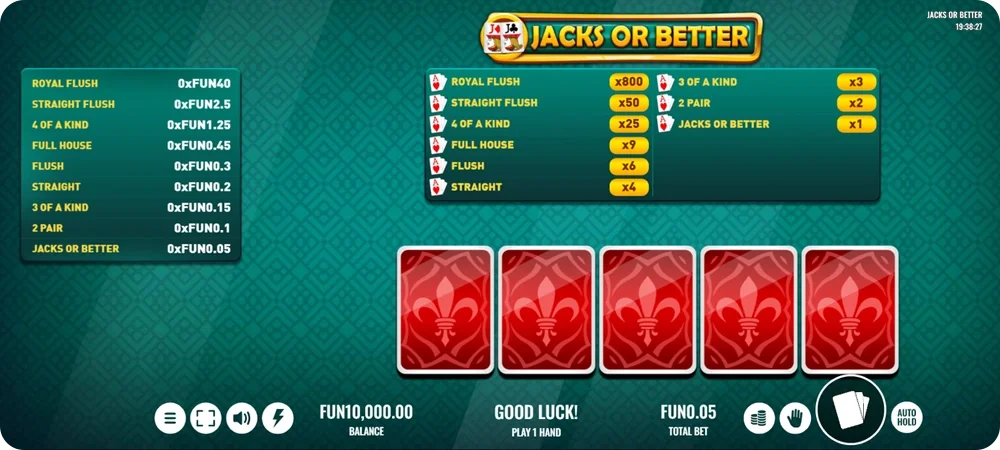
The following steps describe the sequence of play for a standard video poker hand. The same sequence applies across all common variants, though the specific rules governing hand rankings, wild cards, and minimum qualifying thresholds vary by game.
how-to-play-video-poker

Step 1 — Select your coin denomination

The coin denomination sets the monetary value of each credit wagered. Available denominations vary by game configuration; common values range from $0.01 to $5.00 per coin. Selecting a denomination does not deal a hand; it sets the value for subsequent bets.

Step 2 — Select the number of coins to bet

The player selects how many coins to bet per hand, typically between one and five. The total bet per hand equals coin denomination multiplied by coin count. In most video poker variants, betting five coins (the maximum) activates the top-tier Royal Flush payout; this is a fixed game rule built into the paytable. The Bet One and Bet Max (or Bet 5) buttons control this selection in most online interfaces.

Step 3 — Deal the cards 

The player presses Deal to receive five cards face-up from a virtual 52-card deck. The deck is fully reshuffled before each deal; cards already shown in the current hand are removed from the remaining deck and are not available for the draw phase. The player now sees the initial five-card hand and can compare it against the paytable displayed on screen.

Step 4 — Evaluate the hand against the paytable 

Before making any hold or discard selection, the player can review the paytable listing all qualifying hands. The current hand may already qualify (for example, a pair of Jacks in a standard Jacks or Better variant), may be one card away from a stronger qualifying hand, or may not currently qualify at all. The paytable is always visible and defines the qualifying thresholds; this review is a structural part of each hand.

Step 5 — Select cards to hold 

The player selects which cards to keep by pressing the Hold button beneath each card, or by clicking or tapping the card itself in most online interfaces. Cards marked Hold are retained for the final hand. Cards not marked Hold are discarded and replaced in the draw phase. The player may hold any number of cards, from none (discarding all five) to all five (keeping the current hand as dealt). Holding all five cards ends the draw phase without replacement; the current hand is evaluated immediately as the final hand.

Step 6 — Draw replacement cards

The player presses Draw (or Deal, depending on the interface) to replace all discarded cards. Replacement cards are drawn from the same shuffled deck; the cards already dealt to the player and the held cards are excluded from the draw pool. Each discarded position receives exactly one replacement card. The draw is complete when all discarded positions are filled and the new, final five-card hand is set.

Step 7 — Hand evaluation and payout

The final five-card hand is automatically assessed against the video poker paytable. If the hand matches a qualifying entry, the corresponding payout is credited to the player's balance. Payouts are expressed as a multiplier of the total coins bet: for example, a Full House on a 9/6 Jacks or Better paytable pays 9 coins per coin bet, so a five-coin bet returns 45 coins for a Full House. If the hand does not qualify, no payout is made and the bet is lost. The game then returns to the bet selection screen, ready for the next hand. 

Video poker interface and controls

Online video poker interfaces typically present a consistent set of controls, though button labels, visual layout, and exact placement vary between game providers and platforms. The table below lists the standard controls and their functions as they appear across most online versions of the game. 

Control / Button 

Function 

video-poker

  Coin Value / Denomination

Sets the monetary value of each credit wagered 

video-poker

  Bet One 

Increases the coin count by one (cycles through 1 to 5) 

video-poker

  Bet Max / Bet 5 

Sets the coin count to maximum (typically 5); in some variants, also deals the hand immediately 

video-poker

  Deal 

Deals the initial five-card hand; also initiates the draw after hold selection in some interfaces 

video-poker

  Hold (per card) 

Marks the card to be retained for the final hand 

video-poker

  Draw 

Replaces all unselected (non-held) cards and completes the hand 

video-poker

  Paytable 

Displays the full list of qualifying hands and their payout multipliers for the current game configuration 

video-poker

  Balance / Credits 

Shows the player's current credit balance 

video-poker

  Win / Paid 

Displays the amount paid for the most recently completed qualifying hand 

A few controls have behaviours that differ from the standard sequence. The Bet Max button in many interfaces both sets the coin count to maximum and immediately deals the hand in a single action, skipping the separate Deal step. The Hold buttons are applied per individual card and can be toggled on and off before the Draw is confirmed. The Paytable button or tab is accessible at any point in the hand and displays the full payout schedule for the active game configuration, including the Royal Flush two-tier structure. Where a game offers multiple variants or paytable configurations, these are typically selectable before the first deal rather than mid-session. 

Video poker hand rankings

The table below defines the hand hierarchy used to evaluate the final five-card result in standard video poker variants. Wild card variants (Deuces Wild and Joker Poker) modify this hierarchy; see the Variants section below for details on how the ranking structure changes in those games. 

Hand 

Definition 

Example 

Royal Flush 

A, K, Q, J, 10 of the same suit 

A♠ K♠ Q♠ J♠ 10♠ 

Straight Flush 

Five consecutive cards of the same suit 

7♥ 8♥ 9♥ 10♥ J♥ 

Four of a Kind 

Four cards of the same rank 

9♣ 9♦ 9♥ 9♠ K♦ 

Full House 

Three cards of the same rank plus a pair of the same rank 

K♣ K♦ K♥ 4♣ 4♦ 

Flush 

Five cards of the same suit, non-consecutive 

A♦ 7♦ 4♦ J♦ 3♦ 

Straight 

Five consecutive cards of mixed suits 

5♠ 6♦ 7♥ 8♣ 9♦ 

Three of a Kind 

Three cards of the same rank 

Q♠ Q♣ Q♦ 5♥ 8♣ 

Two Pair 

Two separate pairs of the same rank 

J♣ J♦ 8♥ 8♠ A♣ 

Jacks or Better 

A pair of Jacks, Queens, Kings, or Aces: the minimum qualifying hand in standard variants 

Q♥ Q♦ 3♠ 7♣ K♦ 

No qualifying hand 

Any hand below the minimum threshold; no payout 

n/a 

Two structural points about the hand hierarchy are useful to understand. First, the Royal Flush requires exactly five specific cards — A, K, Q, J, 10 of the same suit — and is the rarest hand in the deck. Its high paytable multiplier reflects how infrequently it is formed. Second, the Jacks or Better entry at the bottom of the table represents the paytable floor in standard variants: a pair of tens or lower completes a hand but returns nothing. 

In wild card variants, the hand hierarchy is modified. In Deuces Wild, the four wild cards make three-of-a-kind combinations significantly more common, so pairs are removed from the qualifying threshold entirely. In Joker Poker and Joker’s Wild variants, the addition of one Joker to the deck raises the qualifying floor to Kings or Better or Two Pair, depending on the configuration. The active variant's hand rankings are always visible on the paytable before the first deal. 

For a full reference on how hand rankings apply across all variants, see the video poker hand rankings page.

How to read a video poker paytable

The paytable is always displayed on screen; it lists every qualifying hand and the multiplier paid per coin bet for that hand. Each row represents one qualifying hand, listed from highest to lowest payout. Each column represents a coin count from one to five, and the value shown is the total payout in coins for that hand at that bet level. 

The Royal Flush row typically shows a disproportionately higher value at five coins compared to one through four coins. This is a structural tier built into the paytable; it is a fixed game rule, not a bonus or promotional feature. The bottom row of the paytable is the minimum qualifying hand; any hand below it returns nothing. 

The same variant can appear with different paytable configurations. The example below shows a 9/6 Jacks or Better configuration: "9/6" refers to the Full House paying 9 times and the Flush paying 6 times per coin bet. This is a reference example only; paytable configurations vary by game and platform. 

Hand 

1 coin

2 coins 

3 coins 

4 coins 

5 coins 

Royal Flush 

250 

500 

750 

1,000 

4,000 

Straight Flush 

50 

100 

150 

200 

250 

Four of a Kind 

25 

50 

75 

100 

125 

Full House 

18 

27 

36 

45 

Flush 

12 

18 

24 

30 

Straight 

12 

16 

20 

Three of a Kind 

12 

15 

Two Pair 

10 

Jacks or Better 

For full paytable reference across configurations and variants, see video poker paytables.

How the rules differ by variant

All video poker variants follow the same deal-hold-draw sequence, but differ in deck configuration, wild card rules, minimum qualifying hand, and paytable structure. The table below shows how the most common variants differ from the Jacks or Better baseline. 

Variant

Min. qualifying hand

Wild cards

Key structural difference

video-poker

Jacks or Better

Pair of Jacks 

None 

Baseline variant: 52-card deck, no wilds, paytable starts at Jacks or Better 

deuces-wild

Deuces Wild

Three of a Kind 

All four 2s 

Deuces substitute for any card; Royal Flush split into Natural and Wild Royal Flush at different payout rates, with Natural Royal Flushes paying out more 

double-bonus-poker

Double Bonus Poker

Pair of Jacks 

None 

Enhanced payouts for four Aces and four 2s/3s/4s, Full House and hands. Two Pair payouts are reduced to offset higher payouts for other hands 

joker-poker

Joker Poker

Kings or Better / Two Pair (configuration-dependent) 

One Joker (53-card deck) 

Single Joker acts as wild; minimum qualifying hand raised; paytable adjusted for altered hand frequencies 

multi-hand-blackjack

Multi-Hand Video Poker

Variant-dependent 

Variant-dependent 

Same initial deal played across multiple simultaneous hands; each hand draws independently from its own deck 

video-poker

Jacks or Better

Min. qualifying hand

Pair of Jacks 

Wild cards

None 

Key structural difference

Baseline variant: 52-card deck, no wilds, paytable starts at Jacks or Better 

deuces-wild

Deuces Wild

Min. qualifying hand

Three of a Kind 

Wild cards

All four 2s 

Key structural difference

Deuces substitute for any card; Royal Flush split into Natural and Wild Royal Flush at different payout rates, with Natural Royal Flushes paying out more 

double-bonus-poker

Double Bonus Poker

Min. qualifying hand

Pair of Jacks 

Wild cards

None 

Key structural difference

Enhanced payouts for four Aces and four 2s/3s/4s, Full House and hands. Two Pair payouts are reduced to offset higher payouts for other hands 

joker-poker

Joker Poker

Min. qualifying hand

Kings or Better / Two Pair (configuration-dependent) 

Wild cards

One Joker (53-card deck) 

Key structural difference

Single Joker acts as wild; minimum qualifying hand raised; paytable adjusted for altered hand frequencies 

multi-hand-blackjack

Multi-Hand Video Poker

Min. qualifying hand

Variant-dependent 

Wild cards

Variant-dependent 

Key structural difference

Same initial deal played across multiple simultaneous hands; each hand draws independently from its own deck 

The variant table above covers the most commonly encountered games online. A few points on how to read it:

  • Jacks or Better is the baseline against which all other variants are measured. Its rules are the simplest: a standard 52-card deck, no wild cards, and the minimum qualifying hand is a pair of Jacks or higher. Double Bonus Poker keeps the same baseline rules but modifies specific Four of a Kind, Flush, and Full Housepayouts, which means other rows in the paytable are adjusted to offset the enhanced values.
  • Deuces Wild and Joker Poker introduce wild cards, which change the frequency of certain hands and require a higher minimum qualifying hand threshold. In Deuces Wild, the four 2s acting as wilds make three-of-a-kind combinations significantly more common, so pairs no longer qualify. In Joker Poker, the single Joker in a 53-card deck raises the threshold to Kings or Better or Two Pair.
  • Multi-Hand Video Poker is a format change rather than a rule change. The same initial deal is played across multiple simultaneous hands, each drawing independently from its own deck. The underlying paytable rules are those of the selected base variant.

For a full structural overview of all variants, see the video poker variants page. Dedicated pages are also available for Jacks or Better and Deuces Wild.

Practice video poker for free

Free video poker is available with no deposit or registration required. Demo play uses virtual credits and has no real-money outcomes; it is a useful way to follow the deal-hold-draw sequence and observe how the controls, paytable, and hand evaluation work in an online interface. See the free video poker page for access and a full explanation of how demo mode differs from real-money play. 

FAQ

  • How do you play video poker?

    Video poker is played in four steps: select a bet (coin denomination and coin count), receive five cards from a virtual deck, choose which cards to hold (the rest are discarded and replaced), and have the final hand evaluated against the paytable. Qualifying hands receive a payout; hands below the minimum threshold do not.

  • What does 'hold' mean in video poker?

    Holding a card means selecting it to be kept for the final hand. Any card not held is discarded after the initial deal and replaced by a new card drawn from the remaining deck. The player can hold any number of cards from none to all five.

  • How many cards are dealt in video poker?

    Five cards are dealt face-up from a virtual 52-card deck (or 53-card deck in Joker Poker variants) at the start of each hand. After the hold/discard decision, replacement cards are drawn for each discarded position; the final hand always consists of exactly five cards.

  • What is the minimum qualifying hand in video poker?

    It depends on the variant. In standard Jacks or Better, the minimum qualifying hand is a pair of Jacks, Queens, Kings, or Aces. In Deuces Wild, it is Three of a Kind. In Joker Poker, it is typically Kings or Better or Two Pair. The minimum qualifying hand is always shown as the lowest entry on the paytable; any hand below it returns nothing.

  • How do you read a video poker paytable?

    Each row of the paytable lists one qualifying hand and the payout multiplier per coin bet. Each column corresponds to a coin count from one to five. The total payout for any hand equals the per-coin multiplier multiplied by the number of coins bet. The Royal Flush row is structured with a higher multiplier at the maximum five-coin bet; this is a fixed game rule, not a promotion.

  • Does betting maximum coins change how the game is played?

    The deal-hold-draw sequence is the same regardless of coin count. Betting the maximum number of coins (typically five) activates the top-tier Royal Flush payout built into most video poker paytables. All other hand payouts scale proportionally with coin count. The maximum coin rule is a structural feature of the paytable.

  • Can I play video poker for free before betting real money?

    Yes. Free video poker is available with no deposit or registration required. Demo play uses virtual credits with no real-money outcomes and allows you to follow the deal-hold-draw sequence and observe how the paytable and controls work in practice.

Jack Garry is a Los Angeles-based online casino writer and editor with five years of experience reviewing platforms, covering regulated gambling markets, and helping players make informed decisions. Raised in Las Vegas and steeped in casino culture from an early age, Jack brings a perspective to his writing that goes beyond the research.