
How to Play Craps

Fact Checked By:
Cody Aceveda
Last Updated:

Craps looks complex from the outside, but its two core phases follow a clear, repeating pattern. Once you understand the come-out roll and what happens when a point is established, the full range of bets and table behavior starts to make sense. This guide covers everything: how a round works step by step, every major bet type, the table layout, and the specific knowledge beginners need before their first real-money session. 

What is Craps?

Craps is a dice game in which players bet on the outcome of a roll, or a series of rolls, of two six-sided dice. One player at a time takes the role of the shooter and rolls the dice. All other players at the table can also place bets on the same outcomes. The game has two phases: the come-out roll, which either ends the round immediately or sets a point number, and the point phase, in which the shooter rolls until the round resolves. 

The Craps Table

Understanding the table layout before your first session reduces confusion significantly. The craps table is symmetrical, with the same betting areas mirrored on each side for players standing opposite each other. 

Area 

Position on table 

What goes here 

Pass Line 

Runs around the outer edge 

Pass Line bets placed before the come-out roll 

Don't Pass bar 

Inside the Pass Line 

Don't Pass bets; '12 bars' notation indicates the push rule 

Come / Don't Come 

Centre section 

Come and Don't Come bets placed after the point is set 

Place number boxes (4-10) 

Along the top 

Dealer places Come bets and Place bets on specific numbers 

Field bet 

Large centre area 

Single-roll bet covering 2, 3, 4, 9, 10, 11, 12 

Proposition bets 

Centre of the table 

Managed by the stickman; all single-roll and Hardway bets 

The puck is an ON/OFF disc the dealer moves to track the current game state. When the puck shows OFF, no point has been set and the next roll is a come-out. When it shows ON and sits on a number, that number is the current point. 

New players need only know the Pass Line and Come area to start. Everything else can be learned gradually. 

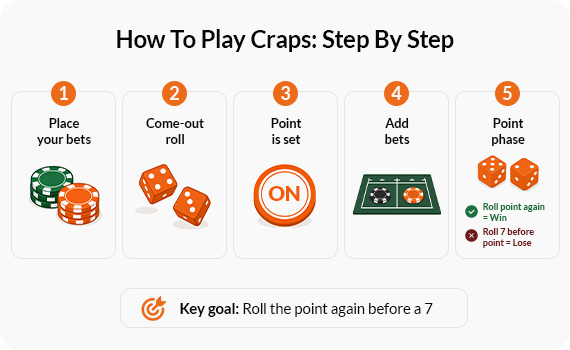
How to Play Craps: Step by Step

The following sequence describes one complete round of craps, from the first bet to the final roll. This is the core pattern every round follows, regardless of which additional bets are in play. 

  1. Place your bet. Before the come-out roll, all players must place at least a Pass Line or Don't Pass bet to participate as the shooter. Other players at the table can bet freely. The dealer puck shows OFF. 
  2. The come-out roll. The shooter rolls both dice. Three outcomes are possible: a Natural (7 or 11), which wins the Pass Line immediately; Craps (2, 3, or 12), which loses the Pass Line immediately; or a Point number (4, 5, 6, 8, 9, or 10), which means the game continues. If a point is established, the dealer moves the puck to ON and places it on that number. 
  3. Additional bets open. Once the point is set, players can add Come bets, Odds bets, and Place bets. These are covered in the bet types section below. 
  4. The point phase. The shooter keeps rolling. If the point number comes up again before a 7, the Pass Line wins and the round ends. If a 7 is rolled before the point (known as sevening out), the Pass Line loses and the dice pass to the next shooter. The puck returns to OFF and a new round begins. 

The Come-Out Roll Explained

The come-out roll is the first roll of every new round. The puck sits on OFF before this roll, confirming no point is currently active. The three possible outcomes work as follows: 

Roll result 

Pass Line 

Don't Pass 

What happens next 

7 or 11 (Natural) 

Wins immediately 

Loses immediately 

Round ends. New come-out. 

2 or 3 (Craps) 

Loses immediately 

Wins immediately 

Round ends. New come-out. 

12 (Craps) 

Loses immediately 

Push (bet returned) 

Round ends. New come-out. 

4, 5, 6, 8, 9, or 10 

Point established 

Point established 

Game continues to point phase. 

The '12 is a push' rule for Don't Pass is one of the most misunderstood mechanics in craps. It is the source of the Don't Pass house edge: without this rule, Don't Pass would have a mathematical advantage over the house. The push ensures a small edge remains for the casino. 

Craps Bet Types

Each bet in craps has its own placement timing, payout, and house edge. The most important bets for new players are covered below. Full payout ratios and house edge percentages for every bet are on the craps odds and payouts page. All bet types are also summarized in the craps hub alongside the other guides in this section. 

Pass Line Bet 

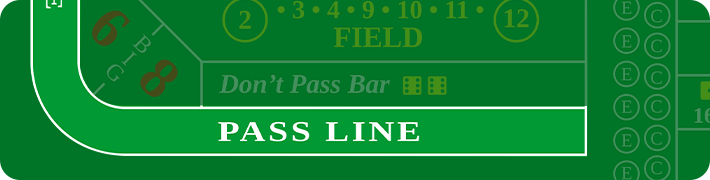
The Pass Line is the most common bet in craps and the logical starting point for new players. Place it before the come-out roll. It wins on a Natural (7 or 11), loses on Craps (2, 3, or 12), and wins if the point is rolled again before a 7 in the point phase. House edge: approx. 1.41%. 
Don't Pass Bet 

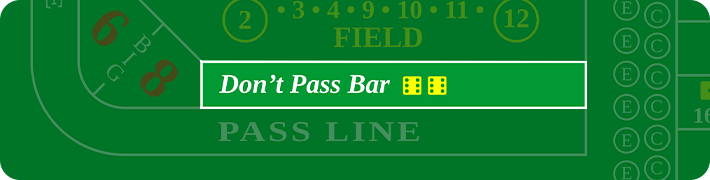
The Don't Pass bet is the opposite of the Pass Line. It loses on a Natural, wins on a 2 or 3, and pushes on 12 on the come-out roll. In the point phase, it wins if a 7 is rolled before the point. House edge: approx. 1.36%, slightly lower than the Pass Line. 
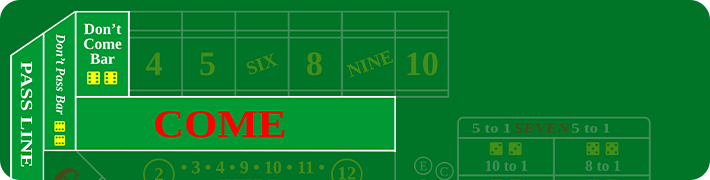
Come Bet 

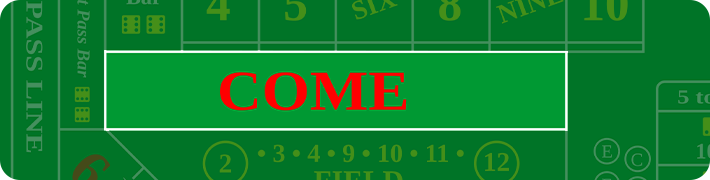
A Come bet can be placed after the point is established. It works exactly like a new Pass Line bet from that moment: the next roll becomes its personal come-out. If 7 or 11 rolls, the Come bet wins immediately. If 2, 3, or 12 rolls, it loses. Any other number becomes the Come bet's own point, which the dealer moves to the corresponding number box. 
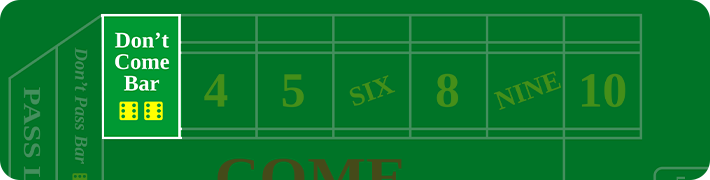
Don't Come Bet 

The Don't Come bet mirrors the Don't Pass and is placed after the point is set. It wins on 2 or 3 on the next roll, loses on 7 or 11, and pushes on 12. Once a number is established as the Don't Come point, it wins if 7 is rolled before that number. 
Odds Bet 

The Odds bet is the single most important concept for new craps players to understand. It is the only bet in craps, and one of the only bets in any casino game, that carries zero house edge. It must be placed alongside an existing Pass Line, Don't Pass, Come, or Don't Come bet. 

Taking Odds (behind a Pass Line or Come bet) pays at true mathematical odds: 2:1 on a point of 4 or 10, 3:2 on a point of 5 or 9, and 6:5 on a point of 6 or 8. 

Laying Odds (behind a Don't Pass or Don't Come bet) pays the inverse: 1:2 on 4 or 10, 2:3 on 5 or 9, and 5:6 on 6 or 8. 

Most tables allow odds of 3-4-5x the Pass Line bet. At maximum 3-4-5x Odds, the combined house edge on a Pass Line + Odds bet drops to approx. 0.37%. This is why experienced players consistently prioritise taking maximum Odds. 
Place Bets 

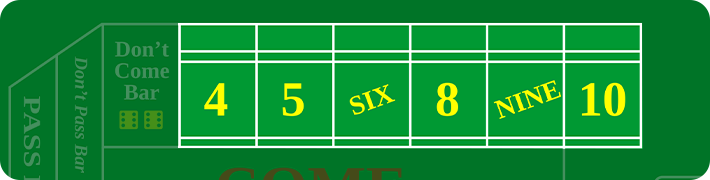
Place bets let you bet directly on a specific number (4, 5, 6, 8, 9, or 10) rolling before a 7, without waiting for that number to become a Come point. They can be placed at any time after the point is established and can be taken down at any time. 

The 6 and 8 are the most favourable Place bets, paying 7:6 with a house edge of approx. 1.52%. Place bets on 6 and 8 must be placed in multiples of $6 to receive the correct 7:6 payout. Place bets on 4 and 10 carry a house edge of approx. 6.67%. 
Field Bet 

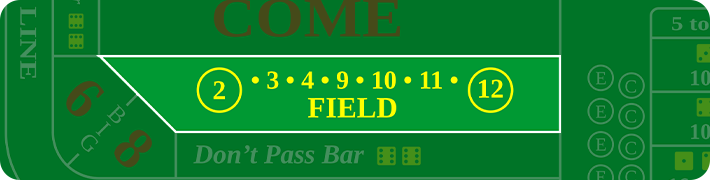
The Field bet is a single-roll bet that wins if the next roll is a 2, 3, 4, 9, 10, 11, or 12. It loses on 5, 6, 7, or 8. The payout on 2 or 12 varies by table (typically 2:1, sometimes 3:1 on 12). House edge ranges from approx. 2.78% (if 12 pays 3:1) to approx. 5.56% (if 12 pays 2:1). 
Proposition Bets 

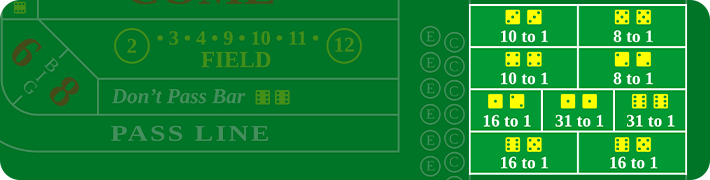
Proposition bets are single-roll wagers on specific outcomes: Any Seven (next roll is a 7), Any Craps (next roll is 2, 3, or 12), Snake Eyes (a 2), Boxcars (a 12), or the Horn (covers 2, 3, 11, and 12 simultaneously). They offer higher payouts than core bets but carry house edges ranging from approx. 11% to over 16%. Full figures are on the craps odds and payouts reference

Craps Table Etiquette

For players joining a live or land-based craps table for the first time, the following conventions apply. Online craps handles all dealer functions automatically, so most of these apply only to live and physical tables. 

  • Join during a come-out roll (puck shows OFF). This is the standard entry point for new players. Exchange cash for chips with the dealer before the roll. 
  • Place your own bets in the areas within reach (Pass Line, Come, Field). Tell the dealer clearly when you need help placing bets in dealer-managed areas such as Proposition bets. 
  • Announce bets clearly: for example, '$12 Place 6' or 'Odds on the Come'. Dealers handle chip placement for many bets, so verbal confirmation matters. 
  • Keep hands away from the table surface when the dice are in the air. This is standard etiquette at any live craps table. 
  • If you are the shooter, handle the dice with one hand only and keep them visible above the table level. 

Beginner Tips for Craps

The following points reflect what the bet data shows. House edge figures and probabilities are stated factually; the decision about which bets to use is yours. 

  • The Pass Line has a house edge of approx. 1.41%. It is the lowest-edge primary bet that resolves across the full round. 
  • Adding an Odds bet once the point is established costs nothing in house edge. The Odds bet pays at true mathematical odds. 
  • The 6 and 8 are each rollable in five different dice combinations, making them the most frequently occurring point numbers. The Place 6 and Place 8 bets carry a house edge of approx. 1.52%. 
  • Proposition bets carry house edges of approx. 11% to 16.67%. This is significantly higher than the Pass Line. Understanding the trade-off before placing them is the relevant consideration. 
  • Free craps is available with no deposit or registration required. Practising the come-out roll and point phase at no cost is the most efficient way to internalise the sequence before a real-money session.

Key Craps Terms

The glossary below covers the terms you will encounter most often when reading craps rules, betting guides, and strategy content. For a full craps glossary, all key terms are defined in the hub section. 

Term 

Definition 

Come-out roll 

The first roll of a new round. Determines an immediate win, an immediate loss, or the establishment of a point number. 

Point 

A number (4, 5, 6, 8, 9, or 10) established on the come-out roll. The shooter must roll it again before a 7 to win the Pass Line. 

Shooter 

The player rolling the dice. 

Natural 

A roll of 7 or 11 on the come-out roll. Wins the Pass Line immediately. 

Craps 

A roll of 2, 3, or 12 on the come-out roll. Loses the Pass Line immediately. 

Seven out 

Rolling a 7 after the point is established. Pass Line loses; dice pass to the next shooter. 

Puck 

The ON/OFF disc used by the dealer to show the current game state and the active point number. 

Odds bet 

A supplementary bet with zero house edge, placed behind a Pass, Don't Pass, Come, or Don't Come bet once a point is established. 

FAQ

The following questions cover the specific concepts new players most often need clarified. 

  • How does craps work for beginners?

    Craps has two phases: the come-out roll and the point phase. On the come-out, rolling 7 or 11 wins the Pass Line; rolling 2, 3, or 12 loses. Any other number becomes the point, and the shooter keeps rolling until they hit that number again (Pass Line wins) or roll a 7 (Pass Line loses). The full rules with every scenario are covered in the step-by-step craps rules guide above. 

  • What is the easiest bet in craps?

    The Pass Line bet is the simplest. Place it before the come-out roll, win on 7 or 11, lose on 2, 3, or 12, and follow the point phase from there. It also has one of the lowest house edges on the table at approx. 1.41%. Full payout comparisons are on the craps odds page.

  • What is an odds bet in craps?

    An Odds bet is a supplementary bet placed behind your Pass Line or Come bet once a point is established. It pays at true mathematical odds with zero house edge, making it one of the best bets available in any casino game. A $10 Pass Line bet combined with maximum Odds at a 3-4-5x table can reduce the combined house edge on the total at stake to around 0.37%.

  • What does 'seven out' mean in craps?

    Sevening out is when the shooter rolls a 7 during the point phase, after the point has been established. The Pass Line loses, all Come bets and Place bets lose, and the dice pass to the next shooter. The round ends and a new come-out begins. For a full craps glossary, every key term is defined in the hub section. 

  • Can I play craps for free before playing for real money?

    Free craps is available with no deposit or registration required. It is the most practical way to run through the come-out roll, practise bet placement, and get comfortable with the game interface before any real money is involved. 

This guide covers every rule a new player needs before their first craps session. The most practical next step is to run through a few rounds in free craps, where no deposit or registration is required. When you are ready to look at bet selection and session structure, the craps betting strategy guide covers the main approaches. 

Sadonna Price is a seasoned writer with over 20 years of experience in online casino, sports betting, poker, and sweepstakes content. She has worked with leading industry brands and specializes in clear, user-focused guides and reviews. Sadonna is known for breaking down complex topics into simple, practical insights that help readers make informed decisions.