Baccarat Glossary
A complete baccarat glossary covering all key terms: from Banker and Natural to Commission, Shoe, and Third Card Rule. Simple definitions for beginners and quick reference for all players.

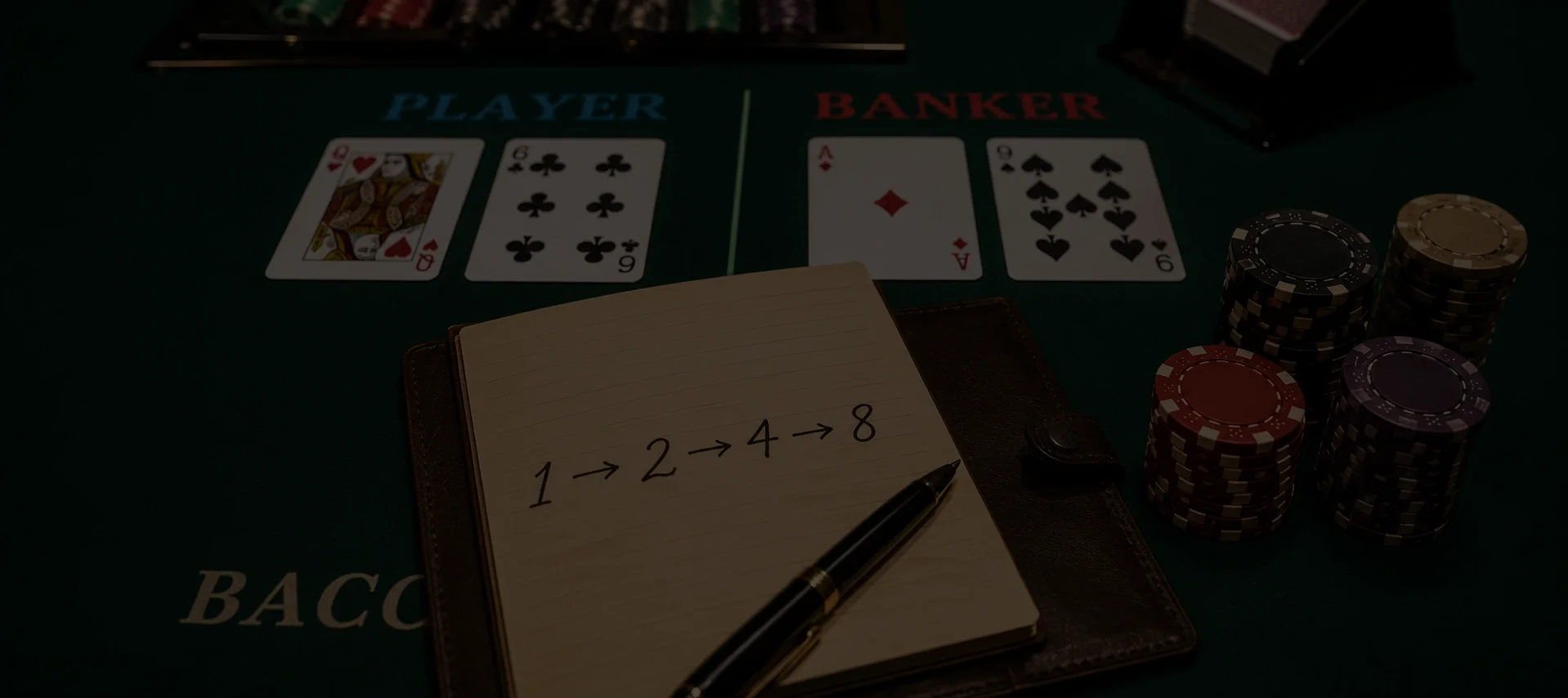

Baccarat is a luck-based game. The outcome of each hand is determined by fixed drawing rules, not by anything a player chooses to do during the round. Strategy in baccarat means bet selection, practical discipline, and bankroll management. It does not mean finding a method to overcome the house edge. This page covers all of those things in one place: core bet selection, beginner tips, bankroll guidance, and an honest look at popular betting systems.
Baccarat is a negative-expectation game. The casino holds a statistical advantage on every bet placed, and no system or approach can eliminate that advantage or guarantee long-term profit.
What strategy can do is more limited but still useful. It can help a player make structurally better bet selections, manage a session budget more deliberately, and avoid patterns of behaviour that accelerate losses. Short-term wins are entirely possible; individual sessions vary considerably from the long-run expected return. But over time, the house edge applies consistently.
Strategy in baccarat does not change the probability of any individual hand. It shapes how a player makes and manages bets across a session.
The most structurally sound approach in baccarat is to stick to the Player and Banker bets and understand what each one carries in terms of house edge.
The Banker bet has the lowest house edge of the three main bets at approximately 1.06%. This is a mathematical feature of how the drawing rules are structured, not a recommendation. The Player bet carries a slightly higher house edge at approximately 1.24%, but pays even money with no commission, which some players find a simpler structure.
The Tie bet has a significantly higher house edge at approximately 14.4% at the standard 8:1 payout. It occurs less frequently than either Player or Banker wins. Side bets, where available, typically carry higher house edges than the main bets and vary between game providers.
Keeping bets consistent and understanding the house edge on each option is the foundation of a sensible approach to baccarat.
These are practical observations about how to approach the game, not performance improvement methods.
Bankroll management is the most practical and defensible aspect of baccarat strategy. It does not affect the probability of any hand. It manages the rate at which the house edge is applied to your funds across a session.
| ✓ Set a session budget before you start. | Decide in advance how much you are prepared to spend. Once that amount is gone, the session ends. |
| ✓ Define a loss limit. | A loss limit is the point at which you stop playing regardless of what has happened in the session. Setting it before you begin removes the decision from the heat of play. |
| ✓ Define a win limit. | Without a win limit, a profitable session can turn negative quickly. Deciding in advance at what point to stop while ahead is as important as defining when to stop while behind. |
| ✓ Avoid chasing losses. | Increasing stakes to recover previous losses is a pattern that tends to accelerate the rate of loss, not reverse it. |
| ✓ Keep bet sizes proportionate to your session budget. | Placing large bets relative to the total budget means the session can end quickly on a short losing run. |
| ✓ Shorter sessions with clear parameters are easier to manage than open-ended play. | An undefined session has no natural stopping point, which makes budget discipline harder to maintain. |
Betting systems are structured staking approaches. They change the pattern and size of bets across a session. None of them change the house edge on any individual bet, and none guarantee profit over time.

In the Martingale system, the stake doubles after each losing bet and returns to the base stake after a win. The logic is that a single win recovers all previous losses. In practice, a sustained losing streak requires exponentially increasing stakes that can quickly exceed table limits or available funds.
|
Feature |
Detail |
|
★ Type |
Negative progression. Stake doubles after each loss. |
|
★ Risk level |
High. A short losing run can require stakes many times the original bet. |
|
★ House edge impact |
None. The house edge applies to every bet regardless of stake size. |

The Paroli system increases the stake after each win, typically doubling for up to three consecutive wins before returning to the base stake. After a loss, the stake reverts to the base immediately. Because progressions are funded by winnings rather than additional funds, the bankroll risk is lower than with negative progression systems.
|
Feature |
Detail |
|
★ Type |
Positive progression. Stake increases after each win. |
|
★ Risk level |
Lower than negative progression. Losses are capped at the base stake. |
|
★ House edge impact |
None. The house edge applies to every bet regardless of stake size. |

In the Fibonacci system, stake sizes follow the Fibonacci sequence: 1, 1, 2, 3, 5, 8, 13, and so on. After a loss, the sequence moves one step forward; after a win, it moves two steps back. The escalation is slower than the Martingale, but a sustained losing run still requires increasingly large stakes.
|
Feature |
Detail |
|
★ Type |
Negative progression. Stake follows the Fibonacci sequence after losses. |
|
★ Risk level |
Moderate. Escalation is slower than Martingale but requires bankroll depth on a losing run. |
|
★ House edge impact |
None. The house edge applies to every bet regardless of stake size. |

The D'Alembert system increases the stake by one unit after a loss and decreases it by one unit after a win. It assumes that wins and losses will eventually balance, which is not a reliable outcome over short sessions. The progression is slower and less aggressive than the Martingale, with lower peak stakes.
|
Feature |
Detail |
|
★ Type |
Negative progression. Stake increases by one unit after each loss. |
|
★ Risk level |
Moderate. Slower escalation and lower peak stakes than Martingale. |
|
★ House edge impact |
None. The house edge applies to every bet regardless of stake size. |
Every bet in baccarat carries a house edge. That edge applies to each individual wager, independent of what happened in previous hands.
Betting systems change the pattern and size of stakes. They do not change the probability of winning any individual bet. A system that doubles stakes after a loss does not make the next hand more likely to win. It only changes how much is at risk.
This is the basis of what is known as the Gambler's Fallacy: the belief that past results in an independent game influence what comes next. In baccarat, each hand is resolved by dealing cards from a shuffled shoe. Previous outcomes have no statistical effect on future results. A run of ten Banker wins does not make a Player win any more likely on the next hand.
Systems that increase stakes after losses can produce short-term recoveries when a win eventually arrives. But they also require progressively larger bets, which can exceed table limits or available funds during an extended losing run.
Over time, the house edge compounds. The longer a session runs, the closer actual results tend to move toward the mathematically expected negative return.
These are patterns worth being aware of, stated as observations.
|
✘ Believing in hot streaks. |
Baccarat hands are independent events. A run of Banker wins does not make a Player win overdue, and vice versa. |
|
✘ Chasing losses. |
Increasing bets after a losing sequence to try to recover does not change the odds. It typically accelerates the rate of loss. |
|
✘ Treating betting systems as winning methods. |
Systems are staking structures. They organise how bets are placed, but they do not overcome the house edge. |
|
✘ Betting without understanding the house edge on each option. |
The Tie bet carries a significantly higher house edge than Player or Banker. Placing it without understanding this means betting at a substantial structural disadvantage. |
|
✘ Playing without a defined budget or stopping point. |
Open-ended sessions without parameters make responsible management much harder. |
The house edge figures and bet types are the same in both RNG and live dealer baccarat. The practical differences are in pace and session rhythm.
RNG baccarat moves faster. Rounds complete in under a minute, which means a session budget can be consumed more quickly if bet sizing is not managed carefully. The pace leaves little time between decisions.
Live dealer baccarat is slower. The real-time deal and fixed betting window introduce natural pauses between rounds, which some players find easier for maintaining discipline.
Free baccarat is available in demo mode with no deposit or registration required. It uses virtual credits with no real-money outcomes.
Free play is useful for observing how the three main bets resolve across multiple hands, how quickly a session progresses in RNG format, and how a staking structure plays out in practice. It replicates real-money variance, but session results in demo mode carry no predictive value for real-money play.
The most structurally sound starting point is sticking to Player and Banker bets, understanding the house edge on each, and managing your session budget deliberately. No strategy eliminates the house edge.
No. Betting systems organise how stakes are structured across a session, but they do not change the house edge on any individual bet. Over time, the house edge applies regardless of the system used.
The Martingale doubles stakes after each loss, which means a sustained losing run can quickly require bets that exceed table limits or available funds. It is a high-risk staking structure that does not change the underlying odds of any hand.
The Banker bet has the lowest house edge at approximately 1.06%, which is a feature of the game's structure. Some players bet on Banker consistently for that reason. Others prefer the Player bet for its simpler payout with no commission. Neither removes the house edge.
Set a session budget before you begin, define both a loss limit and a win limit, keep bet sizes consistent relative to your budget, and avoid chasing losses. These practices do not change the odds, but they make a session easier to manage.
Jack Garry is a Los Angeles-based online casino writer and editor with five years of experience reviewing platforms, covering regulated gambling markets, and helping players make informed decisions. Raised in Las Vegas and steeped in casino culture from an early age, Jack brings a perspective to his writing that goes beyond the research.

A complete baccarat glossary covering all key terms: from Banker and Natural to Commission, Shoe, and Third Card Rule. Simple definitions for beginners and quick reference for all players.

Play free baccarat online with no deposit or registration required. Use demo mode to observe the rules, understand card values, and see how each bet type resolves. No real money involved.
Learn how cards are valued in baccarat. Covers the full card value table, how hand totals are calculated, worked examples, and how baccarat values differ from blackjack.

Learn how to play baccarat step by step. Covers the objective, card values, how a round works, the third card rule, bet types, and tips for beginners.

Explore the main types of baccarat — punto banco, mini baccarat, live dealer, chemin de fer, and more. Covers how each variant works and which format suits different players.

Learn what baccarat pays on each bet type. Covers Player, Banker, and Tie payouts, the house edge for each bet, RTP, side bets, and which bet carries the lowest risk.

Learn what live baccarat is and how it works. Covers real-time streaming, human dealers, how it compares to RNG baccarat, live game types, betting limits, and what to expect before joining a table.

Learn what baccarat is, how it works, and what bet types are available. Navigate to guides on rules, strategy, odds, variants, and free baccarat, all in one place.