


The rapid rise of crash games caught the attention of Professors Robert H. Scott III and Mikhail M. Sher from Monmouth University. Partnering with Professor Jonathan A. Daigle, the researchers set out to investigate the mathematics behind these games in a first-of-its-kind study published in the UNLV Gaming Research & Review Journal, titled Cash or Crash: Return to Player Percentages and Expected Value of Crash Games.
The aim of the Monmouth University duo for the study was to answer a simple question, is there a smart way to play crash games and turn the odds in the player’s favor?
By combining the probability formulas in crash game source code with real-world wagering data from DraftKings' Rocket and crypto pioneer Bustabit, the researchers found a fascinating paradox. A number of higher-stakes players appeared to beat the system in the short term. However, when looking at the overall probability, the conclusion was this was an illusion. The reality is there is no reliable way to become profitable long-term when playing crash games.
Crash games first caught our attention because they games offer a strong community aspect, high entertainment value and a sense of agency for the players, as opposed to games like slots, roulette or baccarat, where the players have no impact on the outcome once the initial bet is placed,” Professor Mikhail Sher told Casino.com.
A New Class of Games
Imagine a screen displaying a solitary green line launching upward into a dark space. As it climbs, a payout multiplier increases in real time: 1.20x, 2.00x, 10.00x. Players in a live online casino watch holding their breath, their finger ready to press a single button showing “Cash Out”. If they wait another second, their modest wager could multiply further. Wait a fraction of a second too long, the multiplier crashes, taking every cent of the wager with it.
Part of the beauty of the crash games is the fact one can choose their own risk level. A bettor looking to double their payout can choose to bail at a multiplier of 2, while someone opting to shoot for the stars can go for a multiplier of 5, 10 or even a 100,” according to Sher.
This is a digital, casino-style, game of chicken and a high-stakes format that has become massively popular in online gambling. We’re talking about the “crash game,” minimalist titles that grew on crypto casinos but are now going mainstream on traditional online casinos.
Understanding Crash Games and Their Rise in Popularity
For players who enjoy traditional slot machines or blackjack tables, crash games offer something unique and with a different type of gaming. These are games that focus on minimalist gameplay with rapid rounds and unique visuals. When a player spins a slot game reel, the outcome is set instantly by a Random Number Generator (RNG) the moment the button is pressed.
Unlike traditional slots where every spin is launched by the press of a button, crash games keep the player actively engaged during gameplay. You get real control over when to cash out, making gameplay feel like you rely on intuition or courage to succeed. Every round begins with a multiplier sitting at 1.00x. Once betting closes, a rocket, visual line, or curve launches upward, and the multiplier moves steadily higher. The payout increases by 0.01x steps at an accelerating rate. All the player needs to do is choose when to hit “Cash Out” before the curve crashes.
Bailing out when the multiplier is still climbing instantly pays the original stake and the multiplier value at the time of cashing out. If the rocket crashes before you hit the button, your entire wager disappears into thin air.
Part of the game's magnetic pull is the promise of reaching high multipliers with massive payouts. In DraftKings' Rocket, for instance, the multiplier can theoretically reach up to 1000x. This means a simple $5 wager would become $5,000 in a matter of seconds. Crypto games like Bustabit have peak multipliers that can occasionally shoot into the tens of thousands.
What the research points out is that surviving in a round to get these life-changing multipliers is an incredibly rare event.
Crash Game RTP Is Something All Players Should Know
Beneath the flashing lights, fun flight animations, and nail-biting countdowns, crash games work through the same single metric as other casino categories, namely the Return to Player (RTP). Understanding the RTP is important for any iGamer as it helps you understand how casino odds work.
RTP shows the theoretical percentage of all wagered money that a game pays back to players over an extended period of time. As the Monmouth researchers explain in their paper, if a game carries a 99% RTP, a player who wagers $1 repeatedly can expect to receive back about $0.99 on average in the long run. The remaining 1% highlights the house edge, which is the mathematical advantage built directly into the software as casino profit.
However, RTP is a statistical average that is calculated over millions of rounds, meaning that no one single player can be sure to recoup their wager.
When Scott, Sher, and Daigle studied the two crash games, they found a clear difference in the base RTP.
- Bustabit: The cryptocurrency pioneer advertises an RTP of 98.87% (representing a lean 1.13% house edge).
- DraftKings’ Rocket: The mainstream fiat-currency title advertises slightly lower RTP of 97% (a 3.00% house edge).
A casual observer may see that 99% RTP has a very generous number, especially compared to the 96% average of online slots. Even so, the main takeaway should not be whether 97% or 98.87% sounds like a "good deal." The reality is any RTP under 100% means the game is mathematically structured to take more than it gives back over time.
Which brings us directly back to the mystery that focuses the Monmouth study. If the underlying odds stack against you, can clever timing and tactical cash-out strategies somehow reshape the mathematical curve in the player's favor?
Finding a Winning Strategy Across Millions of Bets?
To discover if players could somehow outsmart the software, the research team went beyond equations. They needed to see what real gamblers were doing when actual money was on the line.
So, they took on one of the biggest empirical investigations ever conducted into online casino play. Scott, Sher, and Daigle secured access to two massive windows of live gambling activity. First, they tracked over 9,000 observable wagers across 1,041 consecutive rounds of DraftKings’ Rocket. But the real prize was an unprecedented dataset provided directly by Bustabit, offering an impressive 4.36 million individual wagers spanning 27,075 rounds of play.
Having millions of real world bets gave the Monmouth team a window peering into the heated debates that usually fill online gambling forums. On chat boards, players often trade competing theories such as is it better to snatch a quick 1.2x profit or hold out for the life-changing 100x spike? Does setting an auto-cashout beat human reflexes? Do high-stakes players possess some secret discipline, or are they just burning bigger piles of cash?
By matching the cold math built into the game’s software against millions of real-life wins and losses, the researchers could put these questions to the test.
 Photo by: Monmouth University
Bigger Bettors Play Differently, But That Does Not Always Mean Wins
When Scott, Sher, and Daigle began sorting through the mountain of live data from DraftKings’ Rocket, they hit upon an interesting pattern.
To see if bankroll size has an impact on success, the researchers split the visible players in each round into three levels: low, mid, and high-stakes bettors. High rollers have a stereotype of being reckless thrill-seekers taking unnecessary risks, but what the study found defied this trope.
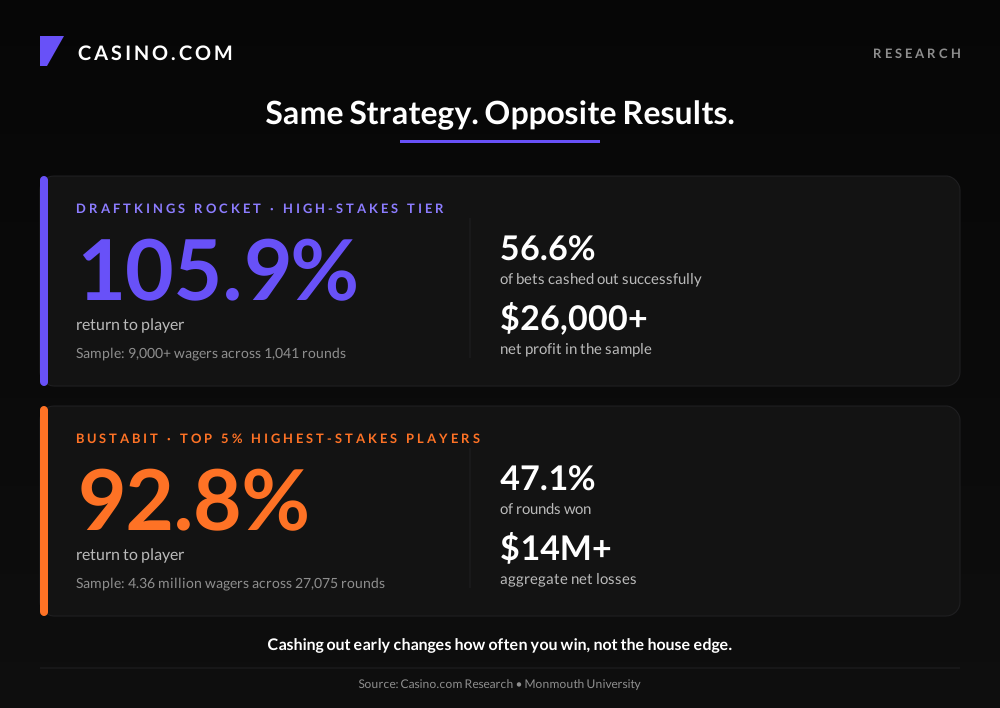
The highest-stakes group, who were wagering the largest sums, won a much higher share of their bets, cashing out successfully 56.6% of the time. This did not come down to luck, but oddly from being cautious. Rather than holding out for big vertical multiplier spikes, the high-rollers consistently cashed out at conservative, disciplined multipliers, averaging around 2.02x with a low standard deviation.
Over the sample, this high-stakes group generated an astounding 105.9% RTP, creating a net profit of over $26,000. By sharp contrast, the low and mid-stakes tiers had painful returns below 90%. At first glance, it looked like the ultimate casino breakthrough showing risking bigger money could mean consistently bigger rewards.
Not so fast. The researchers quickly put a clear disclaimer on this possibility. Throwing more cash at a crash game does not magically transform the mechanics of the software. And this caveat came from the massive Bustabit dataset, which quickly gave a reality check.
When examining Bustabit’s top 5% highest-stakes players across millions of wagers, the researchers observed the exact same disciplined behavior. The result was high-rollers took smaller multipliers and won individual rounds far more often (47.1% win rate). Yet, despite their tactical discipline, their overall RTP ended up at 92.8%, giving them over $14 million in aggregate net losses.
We found that low-stakes players tend to bail at higher multipliers as compared to high-stakes players. This is similar to behavior in financial markets, where larger investors tend to put their funds in well established companies as opposed to riskier small cap stocks and sports betting,” Sher adds, “where smaller bettors might go for high-risk parlays while larger bets will typically go on traditional moneyline and point spread wagers that hit at a much higher frequency. I guess when you don't have much to lose, capital preservation is not really a concern!
The takeaway from the study is this is because of player behavior. It’s true that high-stakes players typically play with more discipline, focusing on incremental gains over one-off pushes for a legendary 1,000x multiplier. Avoiding moonshot plays and cashing early boosts how often they can win, but it does not remove the house edge math built into the game.
Why "Cash Out Earlier" Isn’t a Secret Formula for Crash Games
It is easy to see how a player looking at the high-roller data might jump to an attractive conclusion: If the big bettors win more often by cashing out early, then setting my auto-cashout at 1.20x must be the secret system to print money from a crash game?
The research actually provides a clear and mathematically-driven reality check showing it’s not that simple. It calculates the expected value for setting an automatic cash-out target across any multiplier. The mathematical conclusion shows setting an auto-bet at any multiplier, no matter how small, still produces a negative expected return over the long run. This all comes down to win frequency and long-term profitability.
A player who always exits at low multipliers such as 1.20x or 1.50x will see wins in more rounds. The problem is crash games are coded with random “hard stops,” which are instant crashes at 1.00x. This basically means the round ends before the multiplier curve even moves. Because a single instant crash wipes out 100% of your wager, just one or two sudden explosions can instantly erase dozens of careful low-multiplier wins.
Flip this around and a true thrill-seeker waiting it out for a huge multiplier like 100x will suffer long losing streaks, but just a single win could make up for previous losses. Neither approach is necessarily better in the long term, and the choice the player makes only changes the volatility.
Cashing out early gives you frequent small wins and occasional devastating total losses, while waiting gives you constant losses with occasional rare jackpot-level wins. Both paths lead to the exact same destination: a negative mathematical expectation where the house edge wins.
Crash Games Feel Like Games of Skill, But They’re Really Not
Part of what makes crash games so fun and re-playable is that the choice system in the gameplay gives you a feeling of control. Because your own decision determines when to hit "Cash Out," the game creates a powerful illusion of skill. Slot machines have similar thrilling gameplay mechanics, but you are passive during gameplay.
Crash games feel different, like they are testing your intuition or courage. That’s why a win can feel like a tactical triumph, and a loss feels like you’ve potentially missed something important. This sense of control makes it easy for players to fall for mental traps. You may catch yourself spotting "patterns" in what is actually pure randomness, a psychological phenomenon known as apophenia.
"The last three rockets crashed instantly at 1.00x, so this next one is definitely due for a massive run!"
Or:
"That last launch climbed all the way to 20x, so the next one is bound to explode immediately."
The Monmouth research shows that this type of reasoning is textbook examples of the gambler's fallacy and the hot hand fallacy. The mistaken belief that past random outcomes influence future independent events.
It’s absolutely true that you get control when you play crash games, but merely having more decisions does not automatically mean you can manipulate the underlying math. You are still at the mercy of the RTP and random gameplay, even if you are influencing volatility over a session.
Conclusion: You Can Change How You Play, Not the House Edge
In the end, the research from Scott, Sher, and Daigle uncovers a genuinely interesting connection between human behavior and the cold math of crash games. High-stakes bettors frequently play with surprising conservatism, and in the small sample of DraftKings’ Rocket, that discipline paid off handsomely.
Yet, this is not proof of a cracked code or a secret winning system.
The study's actual conclusion takes a much more realistic stance. There is no winning system, no matter how you play. While high-stakes Rocket players enjoyed a profitable run in the DraftKings sample, Bustabit’s high-stakes bettors had the exact same conservative behavior but still walked away returning just 92.8% of their money overall.
There’s no doubt that strategic choices change the ride, but they don’t really change the destinations. Crash games allow you to choose when to jump off the rocket, but you never have any control over when the multiplier crashes.

Related News

Queens Casino Renderings Released, But Vote Stalls
A consistent fear that the project would not help flooding issues that have become prevalent in Queens’ northwestern area forced them to reconsider.

PAGCOR Targets December 2026 Launch for Verification App
PAGCOR aims to launch a mobile app in December 2026 to help players spot illegal operators, pending a proof-of-concept review by tech partner DCI.

Flutter Plans Up to 1,400 Job Cuts After UK Tax Rises
Flutter has announced plans to cut up to 1,400 jobs across its UK and Ireland operations, blaming higher gambling taxes for the restructuring.

Ninety Labour MPs push Machine Games Duty rise as BGC fights back
Ninety Labour MPs have urged the Chancellor to increase Machine Games Duty on Category B machines, prompting a sharp response from the Betting and Gaming Council before next week’s Budget.
Comoros seeks UK help over disputed Anjouan gambling licences
Comoros has challenged the authority behind Anjouan’s offshore licensing regime, raising questions about its credentials. For British players, however, the requirement for a Gambling Commission licence remains unchanged.

Brazil Betting Ban May Send R$25B to Unlicensed Operators
A new IBIA briefing estimates Brazil's betting ban could drive about R$25 billion in yearly wagering to unlicensed operators, hurting player protection.
AFL Orders Sportsbet to Remove AI-Generated Player Videos
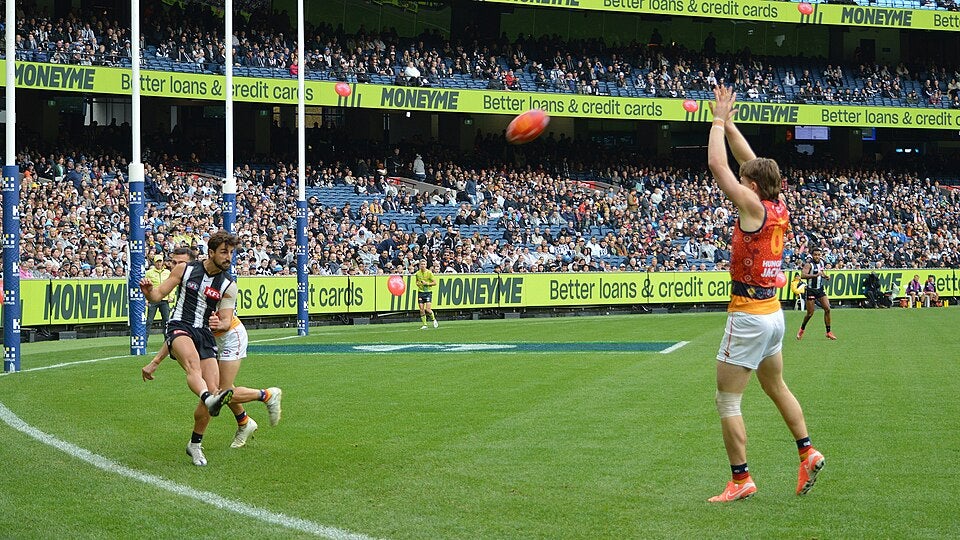
Sportsbet has removed AI-generated videos featuring AFL players after concerns were raised about consent and commercial image rights. The dispute comes as Australia prepares for tighter gambling advertising restrictions.

iGaming Ontario Withheld Its Own Problem Gambling Study
Records obtained by the Toronto Star show iGaming Ontario kept a pre-launch problem gambling study private after it found higher-than-expected rates.

BetMGM, Connor McDavid Renew Responsible Gaming Partnership
McDavid’s promotion of these tools in a Dec. 2025 “Mullet Over” campaign contributed to a 27% year-over-year increase in accounts with deposit limits.

Casino Tycoon Donated $25 Million to Trump’s Ballroom
While it might be life-changing money to some, Adelson donated a ho-hum $25 million to Trump’s ballroom project through the Adelson Family Foundation.
Springfield Wants to Go Public with MGM Casino Dispute
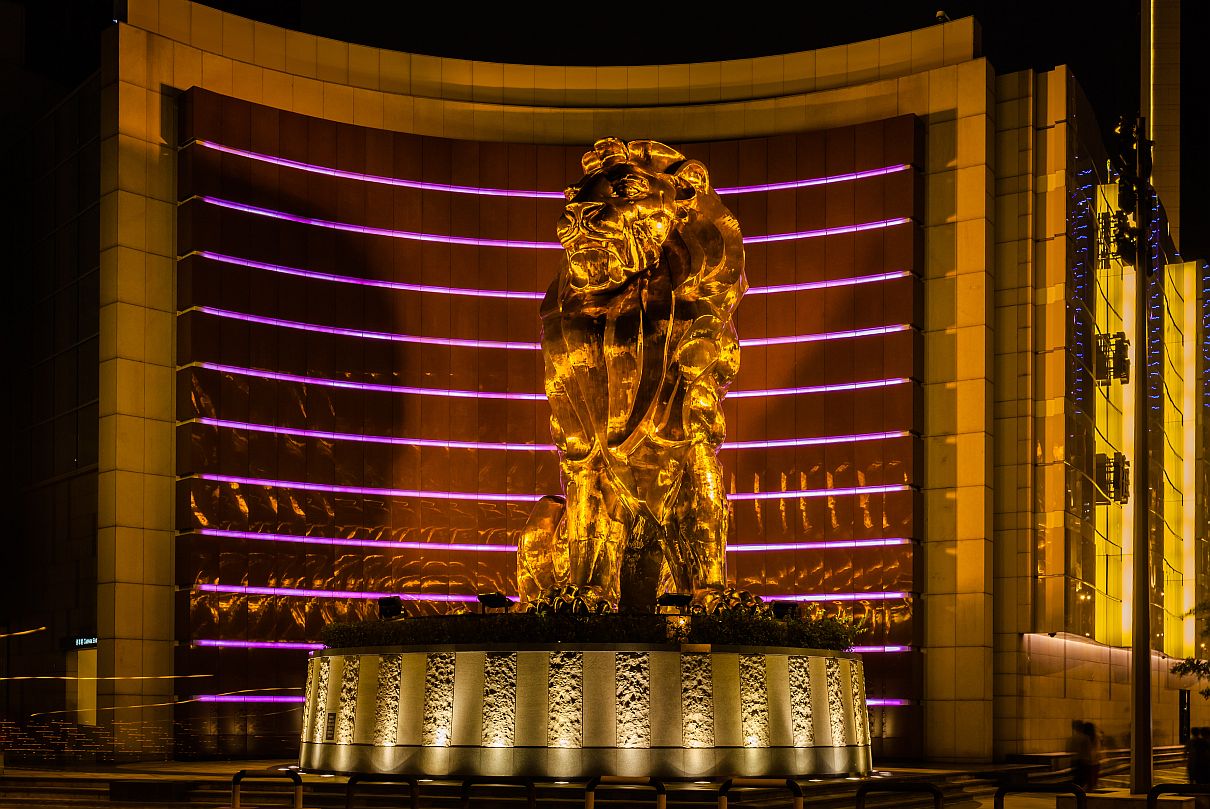
The dispute relates to Springfield’s claims that MGM did not fulfill the obligations it promised when it opened the property in 2018.

Alberta's Legal iGaming Market Hits 50 Sites After Deadline
Gray-market giants Super Group, Apollo and Stake have gone legal in Alberta, pushing the regulated iGaming market from 22 sites at launch to 50.
MGD hike threat exposes divisions across gambling’s high street
A threatened doubling of machine games duty has prompted warnings of widespread closures. But disagreements over bookmakers and arcades could weaken the industry’s response.

Bet365 operators lose appeal against SEK44m Swedish penalties
Two companies operating Bet365 in Sweden have lost their appeals against warnings and combined penalties of SEK44 million for player protection failures.

France’s €11.5bn sports betting market draws ANJ scrutiny
France’s online sports betting market generated €11.5bn in stakes in 2025, but new ANJ analysis raises questions about the players driving certain betting markets.

YouTuber Fooled by Crypto Casino Who Paid Him to Be Quiet
Doherty evidently agreed to a deal without the company without realizing they intended to enforce their stipulations, which prevent him from posting online.
U.S. Feds Sanction Mexican Cartel Casino-Linked Racetrack
The Treasury Department claimed that Club La Molienda operated a betting ring in collaboration with Casino Centenario, a casino in Nuevo Laredo.

PAGCOR Expects Casino Filipino Exit Ruling This Month
PAGCOR CEO Alejandro Tengco says a GCG recommendation on decoupling Casino Filipino will arrive in October, with losses expected at ₱7 billion ($112 million).

New Zealand Names 11 Successful Online Casino Auction Bidders
New Zealand's Department of Internal Affairs has named 11 successful online casino auction participants who secured the right to apply for 15 licences. The auction concluded on 12 October 2026, with the final price reaching NZ$15 million per licence.

Brazil Betting Ban Faces Pushback With 99 Amendments
Lawmakers filed 99 amendments to Brazil's betting ban, and Centrão members plan to push a sports betting carve-out after the Oct. 25 presidential runoff.

Peru Weighs 5% Betting Tax as Chile Tests Offshore VAT
A Peruvian bill would quintuple the betting consumption tax to 5%, while Chile's first quarterly VAT payments from offshore platforms fall due this month.

Alberta iGaming Deadline: Stake In, PokerStars and 888 Out
Alberta's Oct. 13 deadline for gray-market operators has arrived. Stake secured a license, while PokerStars and 888 are cutting off Alberta poker players.

Brazil Betting Ban Wipes Out 74% of Licensed Site Traffic
Brazil's betting ban drove licensed site traffic 74% below normal in a week, while offshore searches held steady and over 3,500 workers lost their jobs.

Maarten Haijer to lead new World Gaming and Betting Alliance
Maarten Haijer has been appointed director general of the World Gaming and Betting Alliance, a new industry body aiming to influence gambling policy worldwide.

National Lottery must lead on player protection, says Sarah Gardner
Sarah Gardner has warned that the National Lottery’s comparatively low gambling risk does not remove the need for strong player protections, with public trust central to its future.

Betano confirmed as Euro 2028 sponsor for UK and Ireland tournament
Betano has been named an official sponsor of Euro 2028, bringing Kaizen Gaming’s expanding football sponsorship strategy to the tournament hosted across the UK and Ireland.
Prize Competition Council appoints Tom Banks as membership grows
The Prize Competition Council has appointed former FDJ United executive Tom Banks as its first executive director, as the UK trade body grows from eight founding members to 65.
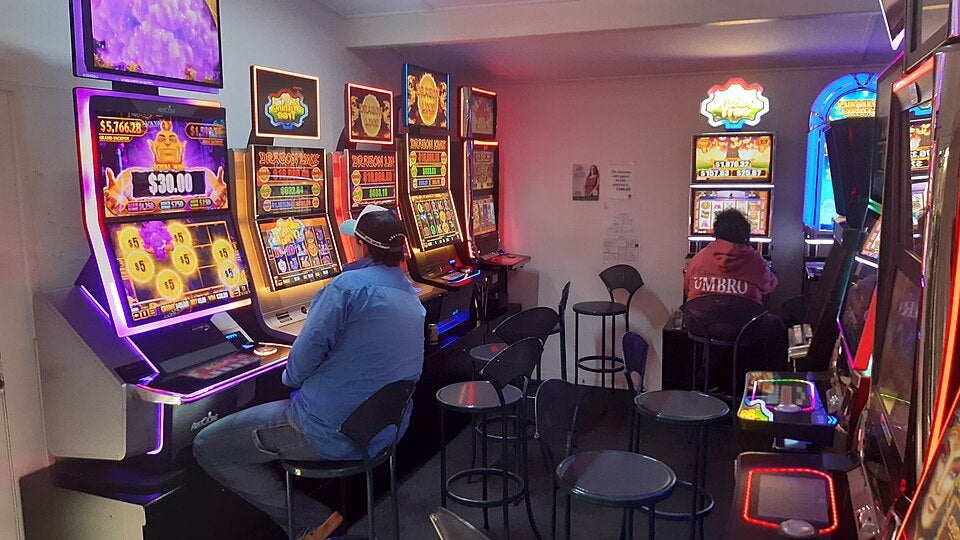
New South Wales Cracks Down on Pokies Venues Breaching Shutdown Rules
Liquor & Gaming NSW has fined two venues and issued further regulatory action following inspections targeting compliance with mandatory poker machine shutdown hours.

Betfred turnover nears £1bn as online closes gap on shops
Betfred’s online business now accounts for 45% of group turnover, narrowing the gap with its shops as the bookmaker faces rising costs and gambling tax changes.
New York Votes to Ban AI-Tailored Betting Promotions
Both proposals are now up for a 60-day public comment period, after which they may return to the Commission for a final decisive vote.

Mavericks Won’t Get Casino in New NBA Arena in Dallas
That’s despite owner and Dumont’s mother-in-law Dr. Miriam Adelson’s funding of lobbying efforts to legalize casino-style gambling in Texas.

Indiana Congressman Warns of Casinos Ahead of Ballot
While three counties are set to vote on potentially hosting a casino, only one will land the facility — assuming any of them achieve the simple majority.
Stake Secures Alberta iGaming License, Plans Oct. 12 Launch
Stake Canada plans to launch its online casino and sportsbook in Alberta on Oct. 12, a day before AGLC's grace period for unregistered operators ends.