responsible-gambling

Responsible Gambling in South Africa 2026

Fact Checked By:
Copley Sutton
Last Updated:

Affiliate Disclaimer

Casino.com may receive commission from some of the casino operators linked on this website. This does not influence the content on this page. The responsible gambling information, support resources, and guidance provided here are objective, factual, and based entirely on player protection. No commercial relationship affects what is written on this page. 

Introduction

Responsible gambling means playing within personal limits you set in advance: a defined budget, a time limit, and a clear understanding that gambling is entertainment rather than a reliable source of income. It does not mean avoiding gambling. It means staying in control of it.

In South Africa, the framework for responsible gambling is built into the licensing system. Every casino holding a Provincial Licensing Authority (PLA) licence is legally required to offer player protection tools, honour self-exclusion requests, and make support services accessible. These are not optional features, they are conditions of the licence.

This page covers the tools available at licensed SA casinos, how to use them, what self-exclusion involves, how to recognise warning signs, where to get support, and what your rights are under South African gambling law. All of the licensed SA casino sites featured on Casino.com ZAR are required to provide the safeguards discussed on this page. 

responsible-gambling

What Is Responsible Gambling?

Responsible gambling is a framework for keeping gambling enjoyable and within boundaries that do not affect your financial wellbeing, relationships, or mental health. The core principle is that gambling is a form of entertainment with a cost, not a strategy for making money. 

The National Gambling Board (NGB) sets the national policy framework for responsible gambling in South Africa. The nine Provincial Licensing Authorities (PLAs) enforce it at operator level. Every licensed casino must meet specific responsible gambling requirements as a condition of maintaining its provincial licence. 

Player tools exist because research consistently shows that early intervention is more effective than late-stage crisis support. The tools available at SA casinos are designed to help players identify and manage their own limits before problems develop. Using them is not an admission of a problem. It is standard practice for informed players. 

South African players benefit from a legally enforced RG framework that gives them enforceable rights: the right to set limits, the right to self-exclude, and the right to escalate complaints if an operator does not comply. Understanding those rights puts players in a stronger position. 

Responsible Gambling Tools at South African Casinos

All PLA-licensed SA casinos are required to offer the following tools. They are typically found in the account settings or a dedicated responsible gambling section. If you cannot locate any of these tools on a casino platform, contact the support team and ask directly. 

Tool 

What It Does 

Where to Find It 

Key Detail 

deposit-methods

Deposit limits 

Caps how much you can deposit per day, week, or month 

Account settings or banking section 

Increases require a waiting period; decreases take effect immediately 

losses

Loss limits 

Caps how much you can lose in a defined period 

Responsible gambling or account settings 

Prevents chasing losses beyond a set threshold 

watch

Session time limits 

Restricts how long you play in a single session 

Account settings 

Platform logs you out when the limit is reached 

Reality checks

Reality checks 

Timed pop-ups during play showing session time and net win/loss 

Account or game settings 

Frequency is usually adjustable 

Account history

Account history 

Full record of deposits, withdrawals, session times, and outcomes 

Account or transaction history section 

Lets you review actual spend without relying on memory 

Self-exclusion

Self-exclusion 

Suspends or permanently blocks access to the account 

Responsible gambling section or support team 

Covered in detail in the section below 

deposit-methods

Deposit limits 

What It Does 

Caps how much you can deposit per day, week, or month 

Where to Find It 

Account settings or banking section 

Key Detail 

Increases require a waiting period; decreases take effect immediately 

losses

Loss limits 

What It Does 

Caps how much you can lose in a defined period 

Where to Find It 

Responsible gambling or account settings 

Key Detail 

Prevents chasing losses beyond a set threshold 

watch

Session time limits 

What It Does 

Restricts how long you play in a single session 

Where to Find It 

Account settings 

Key Detail 

Platform logs you out when the limit is reached 

Reality checks

Reality checks 

What It Does 

Timed pop-ups during play showing session time and net win/loss 

Where to Find It 

Account or game settings 

Key Detail 

Frequency is usually adjustable 

Account history

Account history 

What It Does 

Full record of deposits, withdrawals, session times, and outcomes 

Where to Find It 

Account or transaction history section 

Key Detail 

Lets you review actual spend without relying on memory 

Self-exclusion

Self-exclusion 

What It Does 

Suspends or permanently blocks access to the account 

Where to Find It 

Responsible gambling section or support team 

Key Detail 

Covered in detail in the section below 
All tools listed above must be accessible on mobile, not only on desktop. South Africa is a mobile-first market and the licensing requirements reflect this. If a tool is not functioning on your device, flag it to the casino support team and, if unresolved, to the issuing PLA.

How to Set Limits: Deposit, Loss, and Session

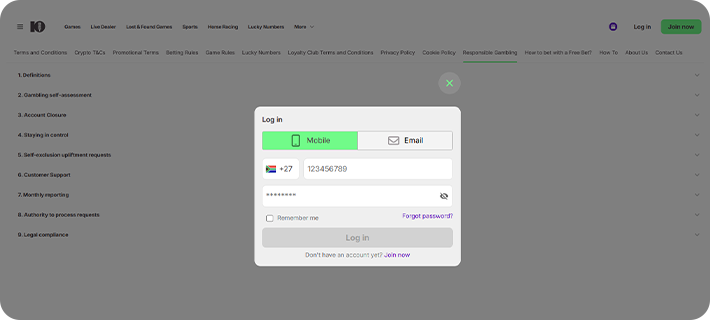
Setting limits takes two to three minutes and the process is consistent across all licensed SA casino platforms, though the exact menu labels vary slightly between operators. The steps below apply broadly. The most important point is timing: set limits before your first deposit, not after a losing session.

  1. Log in to your casino account. 
  2. Open the account menu and look for a section labelled "Responsible Gambling", "Player Protection", or "Account Settings". 
  3. Select the type of limit you want to set: deposit, loss, or session time. 
  4. Enter the amount (in ZAR) or duration, and choose the time period it covers: daily, weekly, or monthly. 
  5. Confirm the limit. It takes effect immediately. 
  6. Repeat for each limit type. Setting all three provides the most complete protection.

10bet-login-screenshot

Cooling-off periods: If you want to decrease a limit, the change takes effect immediately.

If you want to increase a limit, most operators apply a waiting period of 24 to 72 hours before the increase activates.

This delay is intentional. It prevents impulsive decisions made during a session from taking effect immediately.

Set all three limit types before you start playing. Proactive limits are considerably more effective than limits set in response to a loss. Most players who find limits useful report that the session time limit is the one they rely on most. 

Self-Exclusion and Cool-Off Periods

Self-exclusion is a formal request to a licensed casino to block your access to your account for a defined period or permanently. It is a recognised player protection tool, not a punishment. Requesting it is straightforward and confidential.

Two Types of Exclusion

There are two distinct options available at licensed SA casinos, and they work differently. 

Type 

Duration 

Can It Be Reversed? 

Best For 

Cool-off period 

24 hours to 30 days (varies by operator) 

Conditions vary by operator; some require a waiting period before access is restored 

Short breaks when current limits are not working 

Full self-exclusion 

Typically 6 months minimum, up to permanent 

No. Cannot be reversed during the exclusion period. 

When gambling is causing significant harm or you want a long-term break 

Full self-exclusion cannot be reversed during the exclusion period. This is intentional and is a requirement of PLA licensing. Shorter cool-off periods have different conditions depending on the operator; check the responsible gambling section of the specific platform for details.

How to Request Self-Exclusion

To request self-exclusion, go to the responsible gambling section of your casino account settings, or contact the casino support team directly by live chat or email. The request must be processed promptly. If a licensed casino refuses or delays a self-exclusion request, you can escalate the complaint to the National Gambling Board (NGB). The NGB is then required to capture and transmit this data to all license holders within five working days.

  • Confidentiality: Self-exclusion requests are handled privately. The casino is not permitted to contact you for marketing, bonus offers, or promotional purposes during an exclusion period.
  • National register: In South Africa, the National Register of Excluded Persons (NREP) is an established national system. As of the February 2026 amendments to the National Gambling Regulations (Government Gazette No. 54106), the process is centrally managed by the National Gambling Board (NGB); once a person is registered, they are excluded from designated gambling areas and licensed operators nationwide, not just on a per-casino basis.

Consider self-exclusion if deposit or loss limits have not been sufficient, if you find yourself consistently overriding them, or if gambling is affecting your finances, relationships, or daily functioning. Requesting exclusion early is more effective than waiting until harm has escalated. 

Get 200% Match up to R5,000 + 20 Free Spins
Play Now

Warning Signs of Problem Gambling

Most people who develop a problematic relationship with gambling do not experience a sudden shift. The signs develop gradually, which makes early recognition important. The list below is not a diagnostic tool, it is a practical reference. Recognising one or more of these signs is a reason to take stock, not a reason for shame.

  • Spending more money on gambling than you planned, or more than you can comfortably afford to lose 
  • Gambling to recover previous losses, sometimes called chasing losses 
  • Feeling anxious, irritable, or restless when you are not gambling or when you try to stop 
  • Lying to family or friends about how much you gamble or how much you have lost 
  • Neglecting work, family responsibilities, or personal commitments because of gambling 
  • Borrowing money, selling possessions, or using funds earmarked for bills or necessities to gamble 
  • Making repeated unsuccessful attempts to cut back or stop gambling 
  • Continuing to gamble despite being aware that it is causing financial or personal harm

If several of these apply to you, speaking to the NRGP is a practical first step. The service is free, confidential, and requires no referral. Contact details are in the next section.

NRGP and Support Organisations in South Africa

Free, confidential support is available to any South African player who is concerned about their gambling, or about someone else's. No referral is needed. The services below are the primary recognised support resources in South Africa.

National Responsible Gambling Programme (NRGP)

  • Toll-free helpline: 0800 006 008 (free to call, available 24 hours a day, 7 days a week) 
    WhatsApp: send the word WhatsApp to 076 675 0710
  • Services: free telephonic and in-person counselling, referrals to treatment centres, family and partner support, and confidential advice.
  • No referral is required. The service is available to the person gambling and to family members or friends affected by someone else's gambling.

The NRGP is the national designated responsible gambling body in South Africa, funded under the National Gambling Act. It provides professional counselling services and can refer players to appropriate treatment facilities where needed.

Gamblers Anonymous South Africa (GA-SA)

GA-SA is a peer support group for people who identify as having a problematic relationship with gambling. It operates on a 12-step programme and holds meetings across South Africa. GA-SA is a peer support resource, not a clinical counselling service. It works well alongside NRGP counselling for players who benefit from peer connection and regular group support. Meeting information is available on the GA-SA website.

Your Rights Under South African Gambling Laws

South African gambling law gives players specific enforceable rights at any PLA-licensed casino. These are not suggestions, they are legal obligations that operators must comply with. Knowing your rights means you can act when an operator does not meet them.

  • Under the updated NGB 1/1 Form (2026), it is explicitly stated that if an excluded person gambles in contravention of their notice, any winnings accrued during that period may be forfeited and remitted to the National Gambling Board.
  • Right to set deposit, loss, and session limits at any PLA-licensed casino. This is a licensing requirement, not a voluntary feature.
  • Right to self-exclude at any licensed operator. The request must be processed promptly. Refusal or deliberate delay is a breach of the operator's licence.
  • Right to access accurate, complete account history at any time, including all deposits, withdrawals, and session data.
  • Right to escalate unresolved complaints to the Provincial Licensing Authority that issued the casino's licence. The PLA has authority to investigate and impose penalties on non-compliant operators.
  • Protection from targeted marketing during a self-exclusion period. Licensed casinos are prohibited from contacting excluded players for promotional purposes.
  • Under-18 prohibition: gambling is illegal for anyone under 18 in South Africa. PLA-licensed casinos are required to verify player age before allowing real-money play.
  • Data protection rights under POPIA (Protection of Personal Information Act). Your personal documents and account data must be handled securely and used only for the purposes they were collected for.

Budgeting and Safer Play Tips

The most effective responsible gambling habits are practical and specific. The tips below are grounded in what genuinely helps players maintain control, rather than generic advice.

tip-strategyKeep gambling money separate: using a dedicated prepaid payment method (such as OTT Voucher, 1Voucher, or a separate Capitec Pay account) keeps gambling spend visible and separate from daily expenses. For a comparison of all payment options available at SA casinos, the payment methods guide covers each option in detail.

tip-strategySet a gambling budget before you start: decide in advance the maximum you are comfortable spending entirely, and treat it as the cost of the session rather than a loss to be recovered.

tip-strategyNever chase losses: a losing session does not create a statistical obligation for a winning one. Chasing losses is one of the most consistent behavioural predictors of harm.

tip-strategyPlan your withdrawal before you play: decide in advance what amount you will withdraw if you win, and stick to it. Completing FICA verification early means your payout is not delayed when you are ready to cash out.

tip-strategyOnly deposit what you can afford to lose entirely: if the loss of that amount would affect rent, bills, or daily necessities, reduce it until it would not.

tip-strategyUse session time limits: they are the simplest way to enforce regular breaks automatically, without relying on willpower during a session.

For players who want to compare withdrawal processing speed across licensed SA operators, the fast-payout casino comparison covers processing benchmarks and FICA requirements across the major platforms. 

Frequently Asked Questions: Responsible Gambling in South Africa

The questions below address what South African casino players most commonly ask about responsible gambling tools, support, and their rights. 

  • Can I set limits at any licensed SA casino?

    Yes. All PLA-licensed operators are legally required to offer deposit, loss, and session limits. This is a condition of their provincial licence, not an optional feature. If you cannot locate the limit settings on a platform, contact the support team and ask them to direct you. If the tool is unavailable, that is a compliance issue you can report to the issuing PLA. 

  • How does self-exclusion work?

    You request self-exclusion through the responsible gambling section of your account settings or by contacting the casino support team. Under South African law, once a voluntary self-exclusion is activated, a person is legally prohibited from participating in any gambling activity for a mandatory minimum period of 6 months. An "upliftment" (reversal) of the order can only be considered after this 6-month period has lapsed and the individual provides proof of attending the required counseling sessions. 

  • Is responsible gambling support confidential?

    Yes. The NRGP helpline is confidential. Self-exclusion requests are handled privately at the casino level. Licensed casinos are prohibited from using your self-exclusion status for any commercial purpose or contacting you for promotions during the exclusion period. 

  • How do I know if I need help?

    If gambling is affecting your finances, relationships, work, or mental wellbeing, or if you find it difficult to stay within limits you have set for yourself, those are practical reasons to seek support. The NRGP helpline (0800 006 008) provides free, confidential guidance. You do not need to identify as having a serious problem to call. An early conversation is more useful than a late one. 

  • What if someone I know has a gambling problem?

    The NRGP provides support for family members, partners, and friends of people affected by problem gambling, not only for the person gambling. Call 0800 006 008 or send HELP to 076 675 0710 via WhatsApp. Counsellors can advise on how to approach the situation without making it worse. 

  • Can casinos refuse my request to self-exclude?

    No. PLA-licensed casinos are legally required to process self-exclusion requests. If a casino refuses or significantly delays your request, you can file a formal complaint with the National Gambling Board (NGB). The NGB is then required to capture and transmit this data to all license holders within five working days. 

Staying in Control: A Final Note

Every licensed SA casino is required to make responsible gambling tools available, honour self-exclusion requests, and keep support resources accessible. These protections exist because they work. Players who use deposit limits, session timers, and account history tracking consistently report more control over their gambling spend.

If you have concerns about your gambling or someone else's, the NRGP helpline (0800 006 008) is free, available 24 hours a day, and requires no referral. Using it is a practical decision, not a last resort.

For players looking for licensed SA casino platforms that meet all the responsible gambling standards described on this page, the SA online casino guide lists only pre-verified licensed operators. 

Denise Mathey is a South African iGaming writer with 14 years of experience turning casino talk into clear, friendly guides. Her articles cover game rules, bonus terms, and safe play, always backed by careful fact-checking. Off the clock, she bundles the kids into the car for last-minute mini-adventures and hosts upbeat coffee chats that fire women up to chase their own goals.